

All ideas are time


Encerramento e conclusão.
Do Projeto:
Através da ciência da comunicação social, utilizando do método de experimentação em loco, identificando problemas e gerando ações de tentativa, erros e acertos. Baseando-se em videos, estudos e conteúdos pesquisados na web em sites de instituições e de sabedoria popular, foram desenvolvidos e aplicados ações que condizem com a base ideológica do projeto Cooperssaf.
Questão geral:
É possível o desenvolvimento de agricultura familiar e preservação ambiental?
Objetivos:
Trabalhar a ideia de agricultura familiar produção de alimentos e renda, sociabilização e iniciação de inclusão do pensamento de sustentabilidade, boas práticas produtivas e ambientais em pequenos espaços e propriedades.
Inicio oficial Abril de 2022.
Duração 1 ano e 6 meses.
O que foi feito?
1)- Como parte inicial foi introduzido conceitos de cultura organizacional, observação da sustentabilidade como área produtiva, de manejo, área de proteção e preservação.
2)- Limpeza inicial e corte do mato.
3)- Melhorias na cerca e divisão dos espaços.
4)- Abertura e limpeza do brejo de onde provém a água.
5)- Construção do canal com um tanque primário e tanque secundário para criação de peixes e irrigação.
6)- Construção de cacimba para reserva de água limpa de melhor qualidade, destinada ao consumo animal e abastecimento em caso de crise hídrica.
7)- Plantio de bucha vegetal.( resultado insignificante )
8)- Plantio de abóbora. ( resultado insignificante )
9)- Plantio de mamão. ( resultado insignificante )
10)- Plantio de mudas de árvores frutíferas, caju, manga, macieira, acerola.
( resultado insignificante )
11)- Sociabilização entre os participantes incluindo jovens que participaram ativamente da construção do projeto.
12)- Teste de técnicas:
a)- Corte e tratamento de bambu.
b)- Montagem de estrutura com bambus.
c)- Mistura de fazes de composto de barro estrutural e acabamento.
d)- Bioconstrução de estruturas de barro, cimento e madeira.
e)- Técnicas de exploração em meio a ambiente hostil ( abertura de brejo ).
f)- Técnica de observação de engenharia ambiental.
g)- Fazes iniciais de produção de tilápias. ( alimentação, ciclo reprodutivo, qualidade da água e manejo ).
h)- Fazes iniciais para criação de produtos para venda. ( negócio de buchas vegetais, cestas de alimentos orgânicos, peixe fresco e congelado, pimenta e mandioca).
CONCLUSÃO:
Sim é possível em uma escala cooperativada com várias propriedades envolvidas alcançar os objetivos descritos, apresentados e praticados até aqui. É de suma importância a implantação de ideias socioambientais para o desenvolvimento de uma sociedade mais justa e de preservação do meio ambiente para próximas gerações.
Os resultados das ações comprovam a suficiência da implantação destas ideias e ideais.
Encerramento do estudo e suas atividades:
O encerramento do projeto e sua conclusão até aqui se dá principalmente por quetões de cunho financeiro.
Considerações finais:
Para que um projeto de tamanha grandeza ter de fato relevância e ganhar espaço no cenário do desenvolvimento social, é necessário investimentos sendo públicos e/ou privados para a aplicação de tecnologias, assessorias técnicas, assim como, insumos e treinamentos. Tendo como resultado favorável a ser implantado como estratégia de longo prazo.
AGRADECIMENTOS:
“Uma ideia é passível, só se torna possível quando compartilhada.” aps
Obrigado aos amigos e parceiros que compartilharam e participaram tornando esta ideia possível.
About the Project
The COOPERSSAF Experimental Project was created to address the need to organize and implement production, marketing and maintenance systems for rural areas and land. This project provides information and changes that are fully thought out and customized for each space, whether private or occupied on public land, generating development and improvements, as well as highlighting and encouraging cooperation between people and their participation.
One of the main functions of Cooperssaf is to promote dialogue about possible sustainable practices on rural properties, aligning this thinking with the collection of applicable ideas that influence better local income generation, a sense of environmental preservation, inclusion of third parties and a relationship of reuse and disposal of waste. With this set of ideals, observe and create an organizational line so that actions can be applied in the time possible.
It is social, as it can generate work and employment for young people, adults and the elderly who may often be at risk or who need activities to live well and earn some income. It is also social as it generates local income and positively influences the surroundings of each property.
It is about Sustainability, because in all production processes, techniques and infrastructure works are evaluated and applied to ensure maximum sustainability. It is about sustainability because we truly seek economic sustainability by generating income for the families involved and people who pass through or work in the project. It is also about sustainability because plans and actions for the protection, maintenance and management of green areas are part of our daily lives.
It is Family Farming, because this way we can produce part of our food close to the consumer, in small spaces or on larger properties, interconnecting, bringing together people and processes, growing and moving the local market.
It is ecological, as the great challenge is the increase in green areas or even the creation of reserves, recovery and preservation of springs and tributaries, so that it is possible to live in an environment with a better climate.
Great ideas that reflect great needs, if it is possible to dream it is also possible to live.
Action:
A very important action that was conducted and carried out at Fazendinha Pica-pau in São Joaquim da Barra-SP.
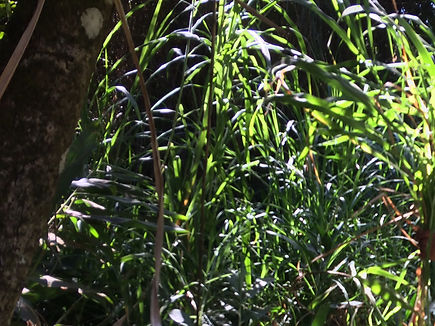
Napie grass

Marsh Lily
Good quality water in sufficient quantity is a common problem on some properties, since without it any agricultural activity is impossible. At Fazendinha Pica-pau, we found a common problem of yellowing of the water. This yellowing was diluted in the water and in portions of a type of gelatinous sludge that made it impossible to use the water for any activity. Through our studies and observations, we concluded that it was a contamination problem caused by plants, a consortium of Napie grass, bamboo and marsh lily. The solution was to clean the marsh so that all the water could flow freely, thus avoiding the accumulation of contaminants. Constant management of the plants and cleaning can be applied monthly or even quarterly depending on the climate and seasons. The end result was much cleaner water that can now be used for irrigation, fish farming and animal use.
Watch this 30-minute video that shows all the stages of the work carried out.
Fish tank
Building a pond for tilapia farming involves several steps, from excavation to water inlet and outlet . Part of the project is the production of food for subsistence and also for sale, generating income.
Watch this 3-minute video that shows all the stages of the work carried out.
Construction of a well
A well's function is to protect springs from silting, and to retain and store water. In this case, this water can be pumped for use in irrigation, animal care, and emergency actions in the event of water shortages. In its construction, the earth and clay from the surrounding area, wood, and a percentage of cement were used in a bio-construction process that causes minimal impact.
Watch this 5 min video and see the result.
Thanks !
Yellow water, management of marsh lily and Napiê grass.
Swamp cleaning and maintenance of water quality for irrigation and fish farming.